MBC in the Transgender Community


Breast cancer in transgender women and men has received little attention. Metastatic breast cancer has received even less. But as transgender people with breast cancer speak out about their treatments and their experiences, that is changing.

Below you can find studies on breast cancer risk in transgender patients, personal stories, and LGBT-specific resources for transgender women and men facing cancer.

Research

Personal stories

Resources and Support

Commonly Used Terms in Clinical Trials

The lists of eligibility criteria for clinical trials are often long and confusing. So are some terms used to describe the trial types, like dose-escalation, dose-expansion, maximum effective dose, and most effective dose.

Below are links to dictionaries that provide good definitions for and explanations of common terms used in cancer research. When in doubt, contact your doctor or the research team if you have a question about the goals of a study or whether you meet the eligibility criteria.

Exercise and Stage 4 Breast Cancer

Research studies are finding that exercise plays an important role in the care of metastatic (stage 4) breast cancer care–including after diagnosis.

We’ve rounded up on some articles, personal stories, research studies, and videos that highlight the importance of keeping–or introducing–exercise in your life. Activities can actually help reduce fatigue. It can even help with the pain. And it can help improve your quality of life.

Learn why it’s safe and beneficial in the articles below.

About

Research studies

Personal stories

How To Get a Newly Approved Cancer Drug

You’ve likely seen news stories announcing new drug approvals and wondered: Will this drug benefit me? How can I get it?

The US FDA Drug Approval and CenterWatch websites track all newly approved drugs. They also provide information about the research studies that led to the drug’s approval. Once a drug is approved, your insurer will need to decide whether to include it in its formulary–the list of drugs it makes available to patients. If it’s not in its formulary, it will not be included in your drug co-pay or co-insurance benefits. There are some drugs that may be in the formulary but require your doctor to obtain prior authorization before your prescription can be filled.

If you read about a new trial, talk to your doctor to find out if the drug might be an option for you. That way, once it is approved, you can find out if it’s covered by your formulary or if it requires prior authorization. Also, keep in mind that some cancer drugs that are approved quickly may not show the same results in real-world settings.

Triple-Negative Breast Cancer Update

For women and men with triple-negative breast cancer, chemotherapy has been the primary treatment option. But as scientists learn more about subtypes of triple-negative breast cancer, clinical trials can better match new targeted therapies with specific triple-negative patients. These advances are what led to the FDA approval in March 2019 of the PD-L1 inhibitor atezolizumab (Tecentriq®) to treat women and men with metastatic triple-negative breast cancer whose tumors test positive for PD-L1. And we can expect to see more trials that target specific subtypes of triple-negative cancer in the future.

True or False?

I will have to pay for ALL medical costs associated with my participation in a breast cancer clinical trial.


Answer: False

While you are in a treatment trial you may receive an experimental, new breast cancer treatment in addition to routine breast cancer care. In this instance, the trial sponsor is responsible for the new breast cancer treatment while many insurers will cover the remaining routine patient care costs. (Patients will still have to pay co-pays and co-insurance amounts, even if the trial is covered by their insurance.)

In fact, Federal law requires most insurance companies to cover routine patient care costs like scans and other tests that take place in the clinical trial. This varies from state-to-state, so it is important to check with your insurance carrier. Medicare has been covering routine costs for breast cancer clinical trials since June 2000.

Most trials do not cover costs such as parking, meals, transportation (if the trial site is not near your home) and lodging. However, there are programs that can help cover these costs.

You can find more information about “Paying for Clinical Trials” in MTT.

New Features on MTS

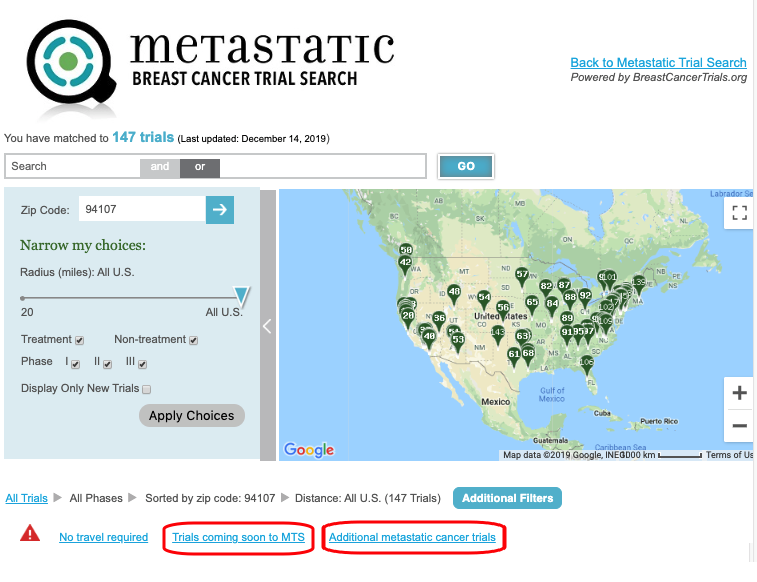
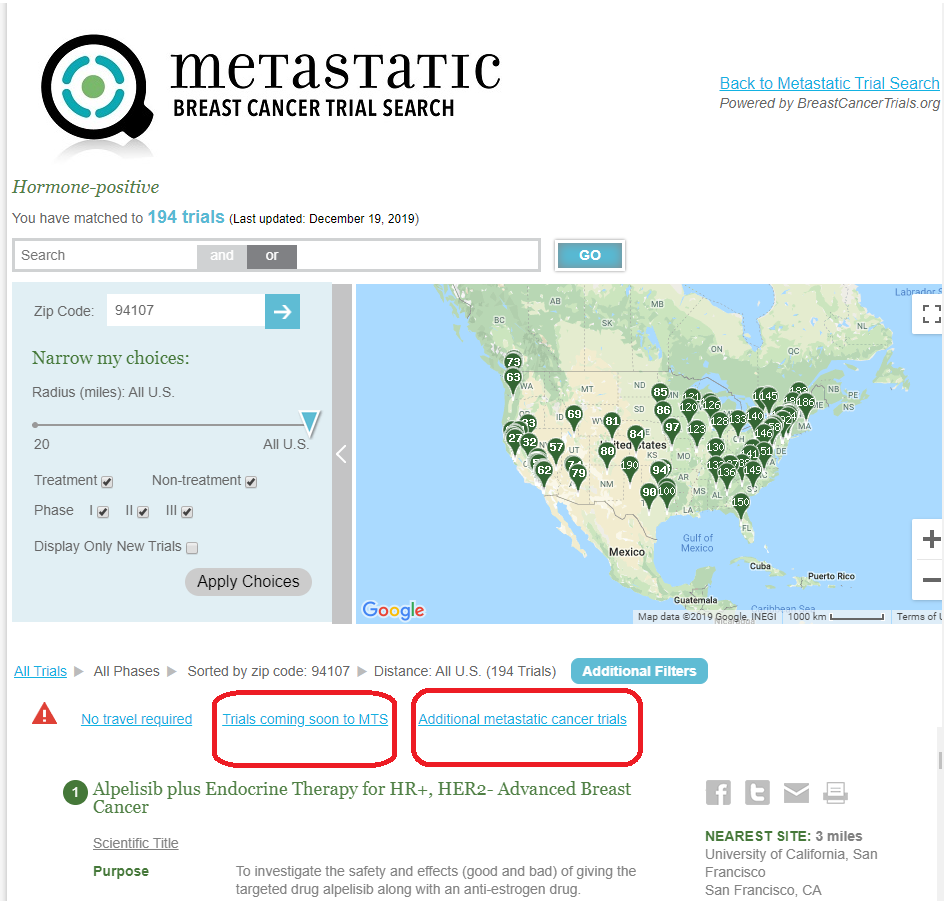
When you use Metastatic Trial Search (MTS), you will match to metastatic breast cancer-specific clinical trials. To help you access all clinical trials available to individuals with MBC, we’ve recently added two new features:

  • Trials coming soon to MTS: We post trials to MTS up to a few weeks after they first appear on ClinicalTrials.gov. Want to see what’s coming? Use our new “Trials coming soon to MTS” feature, which you can find on the trial results page. Clicking here will take you to a list of trials. Click on the trial title, and you’ll go to the full study listing on ClinicalTrials.gov.
  • Additional Metastatic Trials: Want to see early studies that are enrolling patients with any type of solid tumor (not specific to metastatic breast cancer)? Click on our new feature “Additional Metastatic Trials,” which will also be right on your trial results page. This list of Phase I and Phase I/II trials are provided and updated by a metastatic breast cancer patient and advocate Christine Hodgdon of the Storm Riders Network.


Metastatic Trial Search (MTS) is a clinical trial matching tool designed specifically for patients with metastatic breast cancer. MTS provides clinical trial information in a patient-friendly format that makes it easy to quickly see what a trial is studying, who can take part, and where the trial is taking place.

Cancer & PTSD

Post-traumatic stress disorder (PTSD) is an anxiety disorder. Many people associate PTSD with anxiety that can be seen in soldiers, sexual assault survivors, and others who have experienced a frightening or life-threatening situation. Less well understood are the ways that cancer–its diagnosis and associated pain, long hospital stays, regular scans, and more–can trigger PTSD in cancer patients and caregivers.

In the articles collected below, you can learn more about the signs and symptoms of PTSD, how it can be treated, and where to find support.

Big Data & Cancer Research

Cancer researchers have the ability to collect more data on patients in clinical trials than ever before. Analyzing these “big data” sets could provide clues that may help scientists figure out which treatments will work best for a specific cancer patient based on the type of cancer they have and the mutations that are helping it grow.

Below are a collection of articles that can help you learn more about the role big data is expected to play in the next decade of cancer research. We’ve also included a link to the Metastatic Breast Cancer Project, a big data research project to speed the development of new cancer treatments that every person with metastatic breast cancer in the U.S. can join.

Warmest Wishes

Wishing you and your loved ones a joyful holiday season and a Happy New Year!

The Metastatic Trial Talk Team