Telemedicine in Clinical Trials

[et_pb_section fb_built=”1″ _builder_version=”4.16″ global_colors_info=”{}”][et_pb_row _builder_version=”4.16″ background_size=”initial” background_position=”top_left” background_repeat=”repeat” global_colors_info=”{}”][et_pb_column type=”4_4″ _builder_version=”4.16″ custom_padding=”|||” global_colors_info=”{}” custom_padding__hover=”|||”][et_pb_text _builder_version=”4.23.2″ background_size=”initial” background_position=”top_left” background_repeat=”repeat” global_colors_info=”{}”]

June 2020

Telemedicine in Clinical Trials

COVID-19 brought telemedicine, sometimes called telehealth, to the forefront of healthcare. But it’s been available in some health practices for several years.

“Telemedicine” is the practice of seeing your doctors virtually from wherever you are. During the pandemic, many doctors switched to “seeing” patients by phone or video chat, as long as the patient’s needs could be met. Less certain was how telemedicine could be used to keep monitoring people enrolled in clinical trials.

Below, you’ll find resources that discuss how telemedicine may be used in drug trials, and how it might lead to faster, more efficient, and more diverse trials. You’ll also find a link to listen to an expert discuss how telemedicine may be the future of clinical trials.

[/et_pb_text][/et_pb_column][/et_pb_row][/et_pb_section]

Do You Know Your Rights as a Cancer Patient?

All cancer patients have certain rights. Some are guaranteed by federal law. Your state may have additional laws it has added to further protect patients. Your health care providers may also post their own patient bill of rights. There also are Bills of Rights that pertain specifically to people participating in clinical trials.

Below are some of the Bills of Rights that protect you as a patient. We’ve also included a Bill of Rights developed for Caregivers. In various ways, they all underscore the same key point: Cancer patients are not and should never be made to feel powerless. Your care should be centered on your needs, not the needs of your health care providers.

Commonly Used Terms in Clinical Trials

The lists of eligibility criteria for clinical trials are often long and confusing. So are some terms used to describe the trial types, like dose-escalation, dose-expansion, maximum effective dose, and most effective dose.

Below are links to dictionaries that provide good definitions for and explanations of common terms used in cancer research. When in doubt, contact your doctor or the research team if you have a question about the goals of a study or whether you meet the eligibility criteria.

New Features on MTS

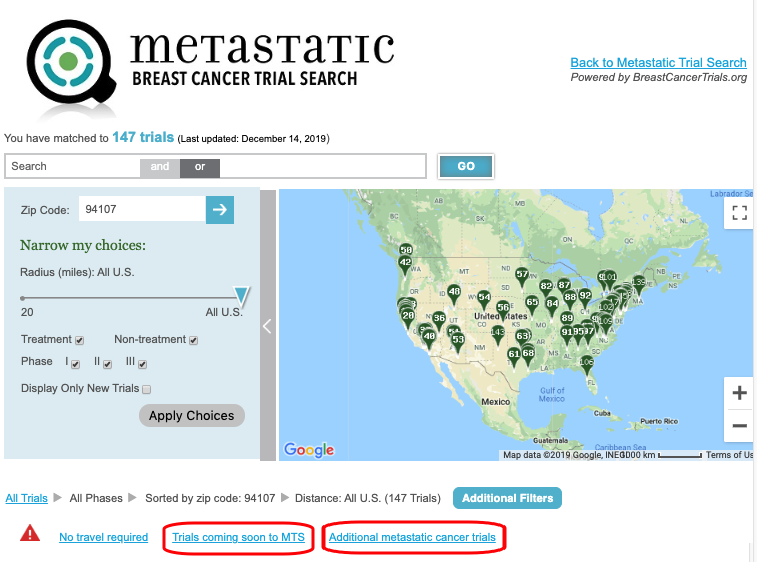
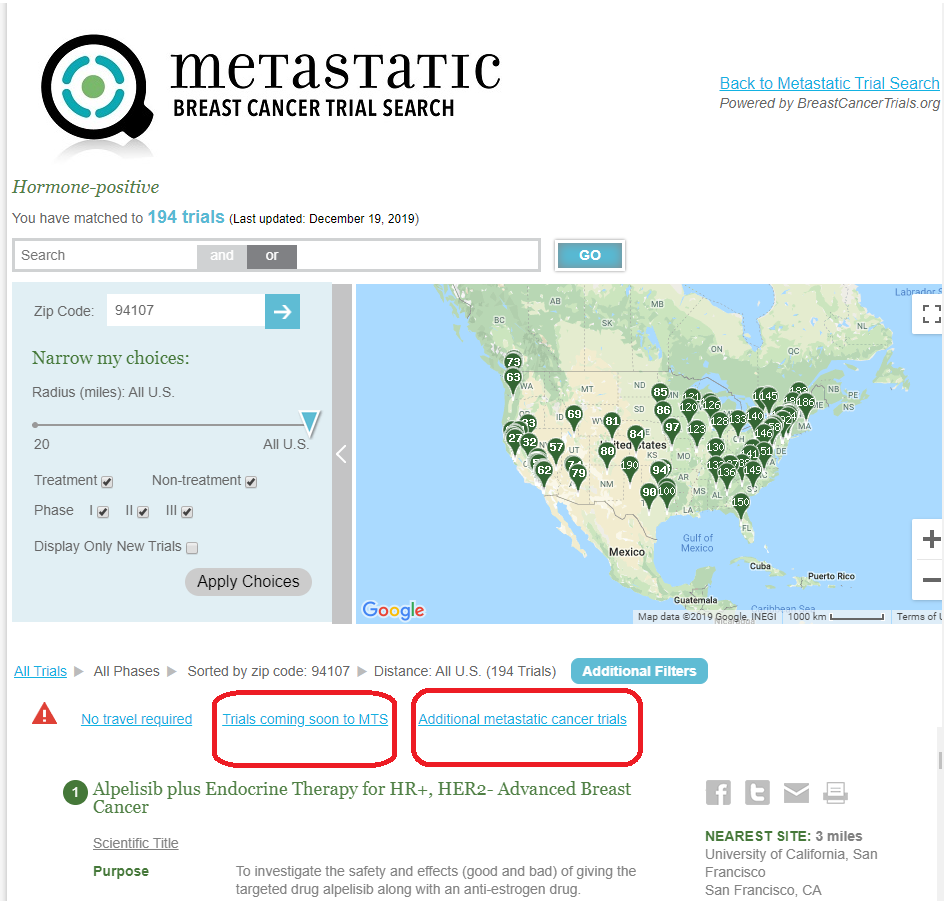
When you use Metastatic Trial Search (MTS), you will match to metastatic breast cancer-specific clinical trials. To help you access all clinical trials available to individuals with MBC, we’ve recently added two new features:

  • Trials coming soon to MTS: We post trials to MTS up to a few weeks after they first appear on ClinicalTrials.gov. Want to see what’s coming? Use our new “Trials coming soon to MTS” feature, which you can find on the trial results page. Clicking here will take you to a list of trials. Click on the trial title, and you’ll go to the full study listing on ClinicalTrials.gov.
  • Additional Metastatic Trials: Want to see early studies that are enrolling patients with any type of solid tumor (not specific to metastatic breast cancer)? Click on our new feature “Additional Metastatic Trials,” which will also be right on your trial results page. This list of Phase I and Phase I/II trials are provided and updated by a metastatic breast cancer patient and advocate Christine Hodgdon of the Storm Riders Network.


Metastatic Trial Search (MTS) is a clinical trial matching tool designed specifically for patients with metastatic breast cancer. MTS provides clinical trial information in a patient-friendly format that makes it easy to quickly see what a trial is studying, who can take part, and where the trial is taking place.

What Do Drug Names Mean?

Have you ever wondered: How did trastuzumab (Herceptin) get its name? Or why is the biosimilar for Herceptin called trastuzumab-anns (Kanjinti)?

As the articles below explain, the names of cancer drugs are driven by science and advertising. Each new drug starts off with a name comprised of letters or numbers that means something only to the company that created it. If studies show that the drug is beneficial, and if it is approved by the FDA, it will get a generic name and a brand name. The generic name will contain clues to how the drug works or if it is a biosimilar. Brand names will be chosen based on what companies hope to portray, and what the FDA will allow.

Read on to learn more about the art and science of how drugs get their names.

And for a refresher on biosimilars, check out this past issue of MTT.

What Are Inclusion and Exclusion Criteria?

Together called eligibility criteria, inclusion and exclusion criteria outline who can and cannot participate in a trial. This month we share why these criteria are important, as well as about current challenges and efforts to optimize eligibility criteria.

OS vs. PFS: What You Need to Know

Clinical trials are set up to look at specific outcomes. Click to read about how progression-free survival (PFS) and overall survival (OS) are used to measure treatment effectiveness.

New Guideline Includes Immunotherapy

In March, the immunotherapy Tecentriq® (atezolizumab) became the first to be included in NCCN Treatment Guidelines for metastatic breast cancer. It can be used along with Abraxane® (nab-paclitaxel) to treat patients with locally advanced or metastatic triple negative breast cancer who have a tumor that tests positive for PD-L1.

Immunotherapy is a type of biological therapy that uses the body’s immune system to fight cancer. There are many new types of immunotherapies being developed and researchers are actively studying which ones might work in patients with breast cancer.

Below you will find relevant information about MBC treatment guidelines as well as research news and clinical trials on immunotherapy for metastatic breast cancer.

Genomic Testing: What Makes Your Tumor Grow?

The U.S. Food and Drug Administration (FDA) has approved two tests to identify genetic alterations in tumors. These tests, which are done on a tumor sample, look for hundreds of known genetic mutations and alterations linked to cancer. The results can potentially be used to make treatment decisions.

Genomic tumor testing is currently not the standard of care for breast cancer patients–but one day it might be. Below you can read about the two tests.

Why the Phase of a Clinical Trial Matters

There’s often a lot of information to review when you are considering whether to enroll in a clinical trial. One of the most important is the phase of the clinical trial. Knowing the phase will give you insight into the focus of the trial: safety and dosage, effectiveness and short- and long-term side effects.

Learn more about the phases of a clinical trial in these articles:

Metastatic Trial Search tip: You can search by trial phase on Metastatic Trial Search